The honeymoon
The first week felt like cheating.
We'd talk through a problem, throw it at AI, get fifteen directions back inside an hour, narrow to three, push further, narrow to one. Ideation that used to eat days now ate afternoons. We were generating options faster than we could evaluate them.
I remember thinking: this is what people meant by 10x.
The hangover
The client wanted Figma. Of course they wanted Figma — every client wants Figma, with their design system, their components, their tokens. Reality showed up on schedule.
AI gives you a mockup. The mockup is brilliant. The mockup is also raster, or HTML, or a screenshot in a slide, or sometimes just a description of a layout so good you have to talk yourself out of cloning it pixel-for-pixel. None of it is in Figma. None of it knows your client's design system.
So you redraw it. Frame by frame. Component by component. Every spacing token converted. Every shadow re-derived. Every state — hover, focused, disabled, loading, error, pending — built by hand in the client's library because that's what the design system requires.
We saved a week on ideation. We spent it pushing pixels back into Figma. The math basically broke even.
The honest take: AI didn't make us faster overall on this project. It made the good parts faster and the boring parts worse, because we had more good ideas to translate, which meant more boring translation work. The pink glasses came off fast.
The thing that was actually hard
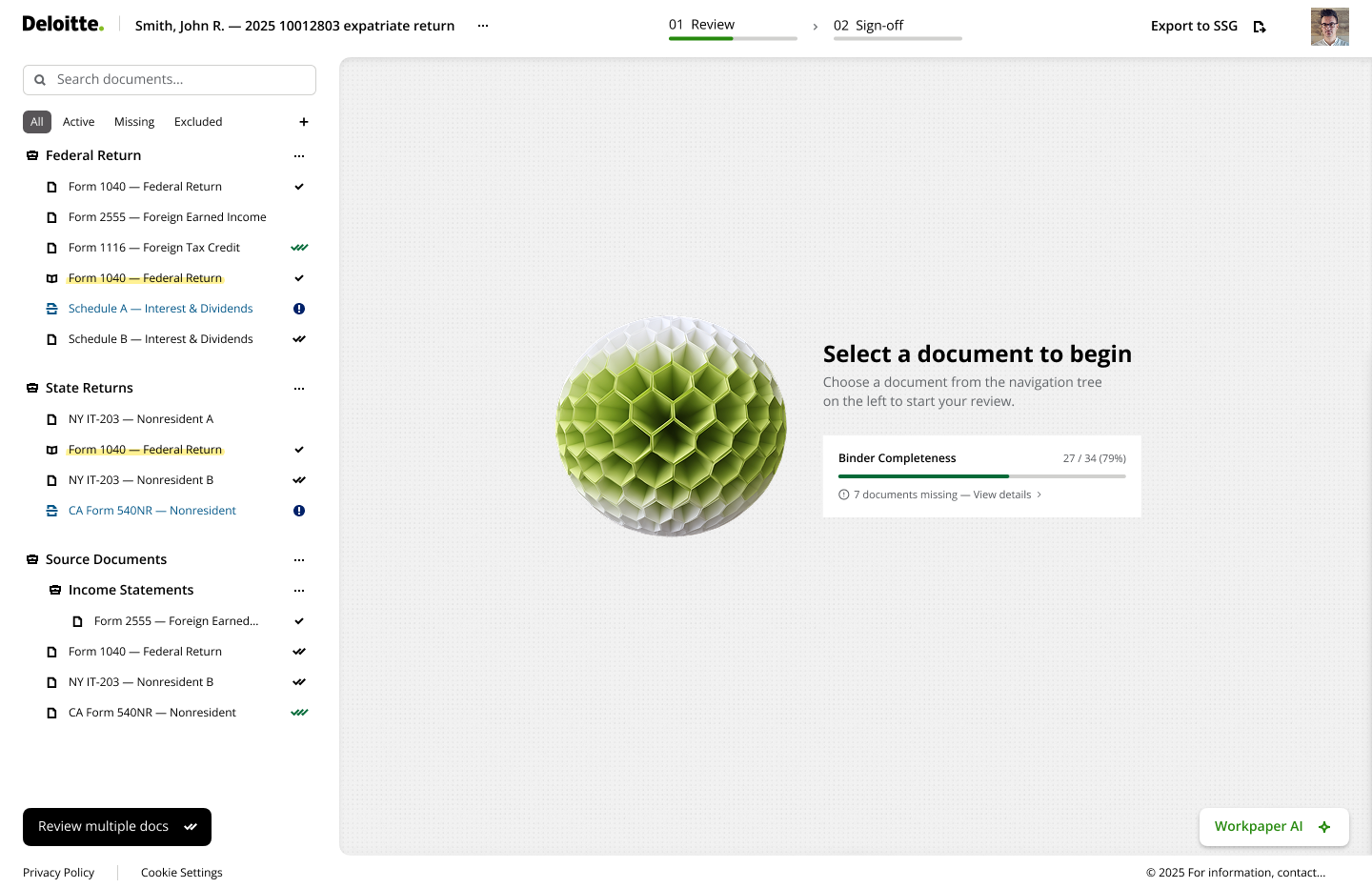
The sidebar tree. That's where the case lived.
Every tax review is a stack of documents in folders. Some are downloaded, some are pending. Some have been reviewed, some signed off, some both, some neither, some force-signed without review — that's a thing, reviewers can skip the review step if they want, which has its own status. And it's role-dependent: one person might be both reviewer and signer, or two different people, or sometimes the system doesn't know yet.
The sidebar had to show all of that. Hierarchy and status, on top of role, on top of doc state, on top of folder-level rollups. Without becoming the spaghetti diagram that ate the user.
The thing that worked: separating status from hierarchy as orthogonal axes. The tree shows where things live. The status indicators ride alongside. Roles get their own affordance, not a fourth color. Pending documents look pending, not like a special kind of reviewed. Once we stopped trying to encode everything in one visual language, the tree got readable.
What got built
Bulk actions for review and sign-off, because nobody wants to click four hundred documents one at a time.
A toolbar with the things tax reviewers actually use — stamps, zoom, a calculator — sitting where their hands already were.
And Work Paper AI, the integration that lets reviewers ask the system questions about the document they're looking at instead of cross-referencing six other tabs. The AI in this project lives in the product, not just the process.
We delivered in three or four weeks. Would have been six without AI. The savings were real but not where I expected — research and ideation collapsed; mockup execution didn't.
The deeper truth
You can't fake the deep work.
AI gave us fifteen good directions. We still had to choose the right one. The choosing didn't get any easier. That's still the job. It will always be the job. Whatever the next tool is, the next one after that, the one we don't have a name for yet — none of them get you out of looking at the problem and deciding what matters.
The honeymoon ends. The work resumes.
The client got their tax review platform. The Excel folders died. And I got promoted out of being the person who has to redraw AI mockups in Figma frame by frame.
So in a sense: AI did get me out of the work. Just not the way I expected.