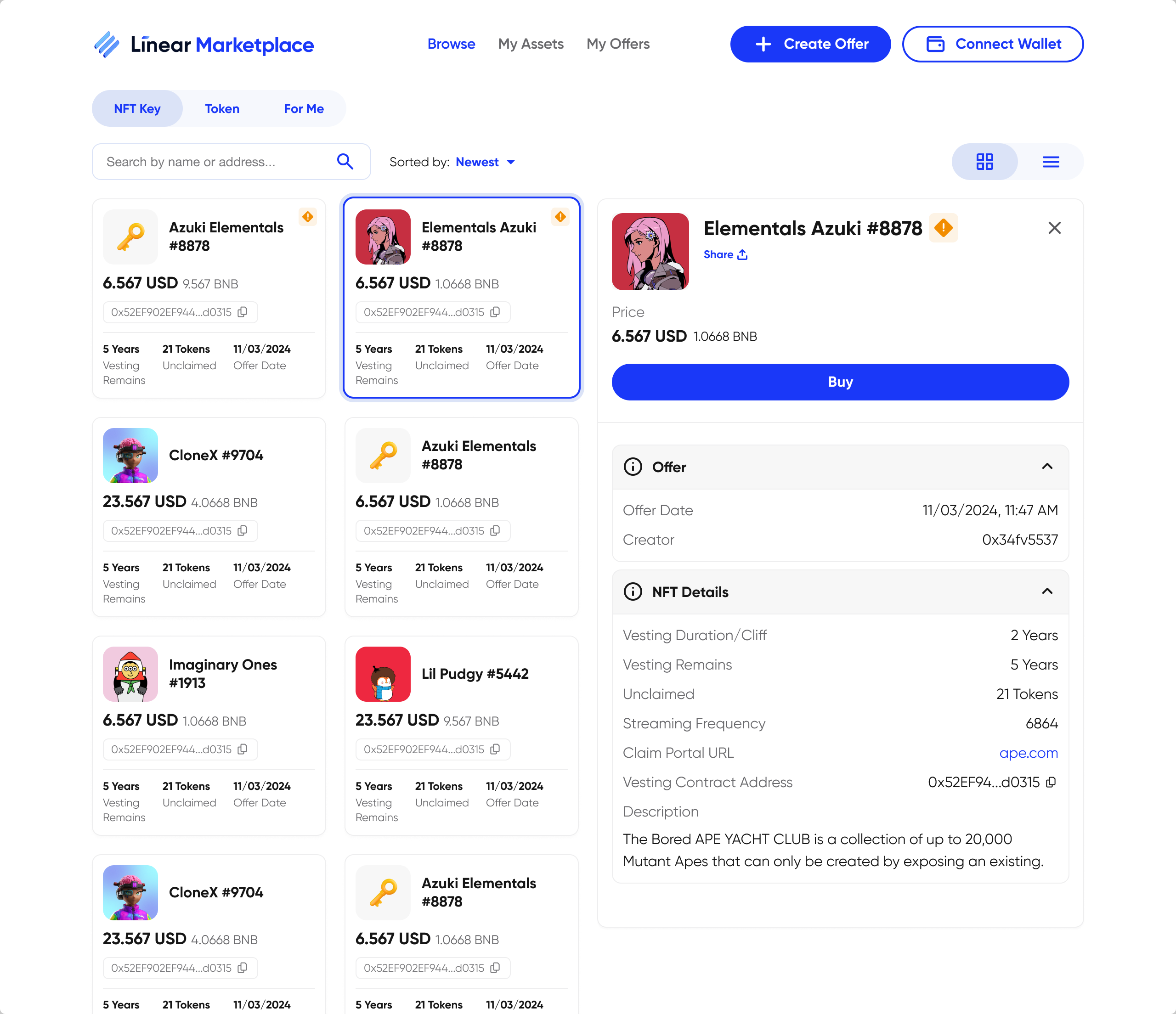
Linear Marketplace — hero

Product Designer

Trinetix · 2023

Linear Marketplace

A crypto marketplace for NFTs and tokens. Learning blockchain UX from scratch. Why every crypto product looks like a slot machine — and what happens when you try to dignify one. Early-career work, looked at honestly.

The brief

A crypto company wanted a marketplace. NFTs and tokens. Standard enough — until you read the second paragraph of the brief, which said the marketplace also had to support selling tokens that had non-transferable clauses written into their smart contracts.

If that sentence didn't immediately set off an alarm, congratulations — you've never read a crypto whitepaper. Tokens often come with transfer restrictions baked into the contract. The marketplace's hook was that it would let you sell them anyway, presumably through some peer-to-peer escrow trick the engineers had worked out.

I won't pretend I understood the legality of this when we started. I'm not sure I understand it fully now. What I understood was that the client wanted it built, and I had a year of design experience to figure out what that should look like.

Where I was when this came in

Early career. I thought I understood design. I had no idea what I didn't know.

That's the honest setup for this one. The version of me that worked on this project had the basics down — visual hierarchy, components, decent Figma chops — but I hadn't yet learned the thing that turns a designer into a senior designer, which is the slow accumulation of being wrong in interesting ways. I learned a lot of that here, and I learned more of it in the years after, looking back.

The case is real. The work shipped. The narrator just wants to be clear he wouldn't make all the same calls now. That's not a bug. That's how careers work.

What I didn't know about crypto

Everything. I knew nothing about crypto going in. Not how blockchains worked, not what gas fees were, not why your wallet sometimes shows three different versions of the same coin, not why you can't transfer a token between chains without going through a bridge that might or might not eat your money.

I knew none of this. I had to learn all of it just to draw the screens.

The rough sequence of revelations:

A token lives on a blockchain. Different tokens live on different blockchains. If you want to sell a token that lives on chain A using a marketplace built on chain B, you pay fees in chain B's currency, even if you don't own any. So you have to acquire some of chain B's currency first, which means another transaction, which means another fee. The fees compound. A user trying to sell a $20 NFT could realistically pay $15 in fees across three transactions to get it done.

And the wallet shows all of this. Every fee, every chain, every gas estimate, in raw hex-like numbers, with no translation. The user is expected to know what any of it means.